The good news is that Bald eagles have rebounded in the US–so much so, that I see one at my house every few months.
The bad news is that one showed up just as my osprey was out. My bird was circling the lake when an eagle attacked from the rear. Orville noticed this and dove low over the water, zigging and zagging. This did not prevent the eagle from quickly footing his back, flinging a couple of his feathers to the wind.
Orville immediately returned close to me in the yard, and the eagle peeled off. Orville sat for a minute, catching his breath, his cries muted. Plaintiff maybe?
He soon flew back to his perch and began fishing. The fish are still slower to come to food than the turtles (which come in great numbers), so no luck again.
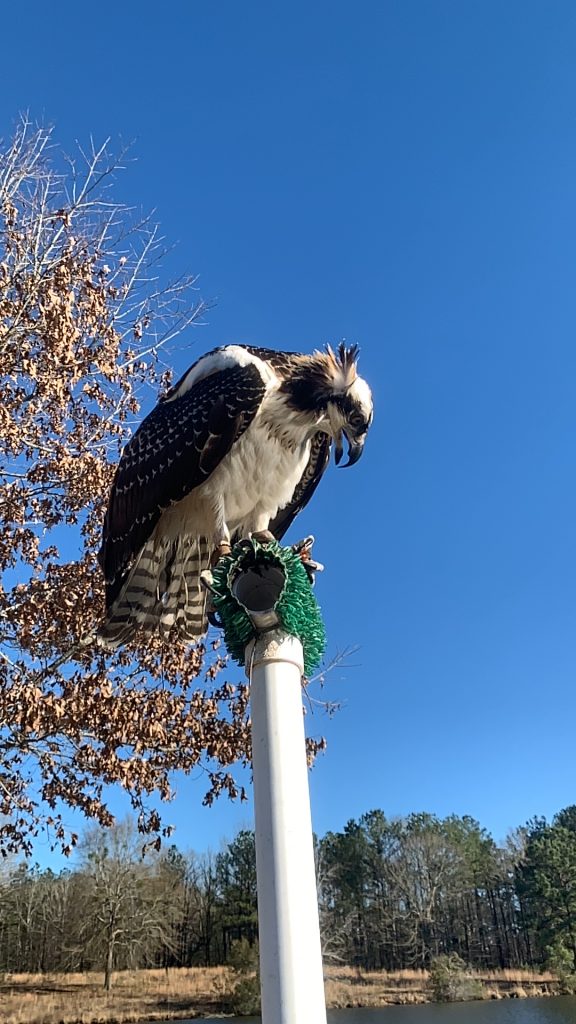
Orville is molting some primaries, so I’ve been keeping his weight up. So “up,” as a matter of fact, that he decided to sit on the chimney and not return. All night.
Being worried about a Great Horned owl half the night made it hard to wake at the break of dawn. But, I was out there anyway in the front yard, fish on my glove, whistling at the roof. It’s a good thing we don’t have close neighbors.
He still didn’t return, but he seemed a little more interested than the night before, giving an occasional “feed me” call.
I got a lawn chair and a book and settled in. After a two-hour vigil, I was rewarded by his reluctant return.
After a small meal, he behaved better the next day and the next. Three days after his night out, he was back to his reasonably responsive self.
I can’t recall if I mentioned the redtail attack. Orville was circling the pond when a wild hawk dove at him from trees on a hill. Orville jinked evasively, but the redtail made one successful swipe, knocking off a few back feathers.
He seemed unharmed, but his calls were slightly quieter for at least two weeks. I know this because my son measured his calls with a decibel meter daily for a class project.
After some fishing on the wing at a newish pond, the osprey was attacked in the air by a Canada goose. (I knew this was potentially dangerous since I recently watched a video of a goose capturing and drowning a seagull.) Orville pulled away, and the goose returned to guarding his nest which the osprey had flown over. The chastened osprey left the area and headed back to his more familiar pond.
After flying, diving, and bathing in his usual haunt, he flew over a pasture. An adult red tail streaked up from behind and attacked. A mere split-second tangle sent a couple of feathers flying. The hawk did not pursue as the osprey flew away low and fast.
Orville didn’t return to my whistles and was quiet. He finally started chirping in the front yard and returned to the glove–clearly shaken. Blood stained some of his pond-dampened belly feathers, but he acted fine as I flew him on a third pond. (No fish about).
Orville has had no luck this spring, and the fish are still slow. I decided to take him to a smaller, more “fishy” pond. After easy transfers and a peaceful 1.5-hour trip, he left the glove towards the feeding fish.
Instead of a direct dive, he began circling about 50 feet off the water, staring down, making several false stoops until he finally executed the quintessential straight-down osprey dive!
It was so much fun to see him hunting for a good while–soaring, diving, wheeling about–that I was not really disappointed that the trip yielded no fish catch. He returned well to several tidbits and then finally for his whole fish.
The drive back was smooth. The system of handling and transporting seems to work fine. I hope he continues to hunt on the wing.
After several months of almost daily dunking, the tail mount disappeared. Fortunately, it disappeared before I mounted a transmitter on it. I haven’t been fishing him due to the cold, but I have been flying him a lot. I get very nervous without telemetry these days. He ranges fairly widely and gets pretty high on the windy days. Plus, I have him at high weights to handle the recent cold snap.
I replaced the mount with the second-to-largest, Marshall metal, single-feather mount, advertised as suitable for red-tails. This mount is gold-colored, whereas the one that fell off (or was preened off) was platinum (in color, I mean).
The new one seemed to fit well enough. It crimps on with pliers. I used the needle-nose style, being too cheap to spring for the specially made installation tool. For wire crimping, a special tool is critical. Hopefully, feathers will be more forgiving of a less-than-perfect crimp. I did not use glue on the old one, but I did on this one (cyanoacrylate). It seems to be functioning fine. I hope I don’t lose a transmitter in the pond.
As stated before, the tail mount and transmitter seem to cause no difficulties in diving. The bird has never seemed bothered by it.
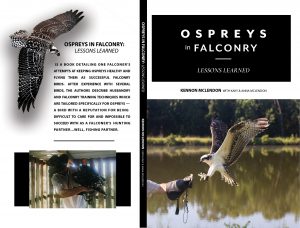
Also, Western Sporting is now stocking and selling the Ospreys in Falconry book. He has already sold the first 30 copies I sent. I am excited about this because they are such a pillar of the falconry publication scene.
The bird is flying high and far now. He will bathe once or twice, then fly 30-45 minutes. On windy days, he really swoops and soars. Today he was reluctant to come back down for food. He also perched on treetops and a telephone pole for the first time.
It looks like he is torn between hanging around for easy food and heading out. When high or fast, he is reluctant to descend or really put on the brakes to return to the glove. This is at his highest weights. He doesn’t leave the yard at his lowest weights. There are no fish for him to catch, so I am just letting him exercise and observing his behavior.
He stays within eye contact and flies back overhead in response to whistles. He occasionally whistles back. There are no surface fish to speak of, but he sure has been circling the ponds, a couple of hundred feet up–the perfect set up for a real dive. I hope he continues that behavior when warm weather returns, but he is clearly not under good control at his high weights even when his crop is empty.
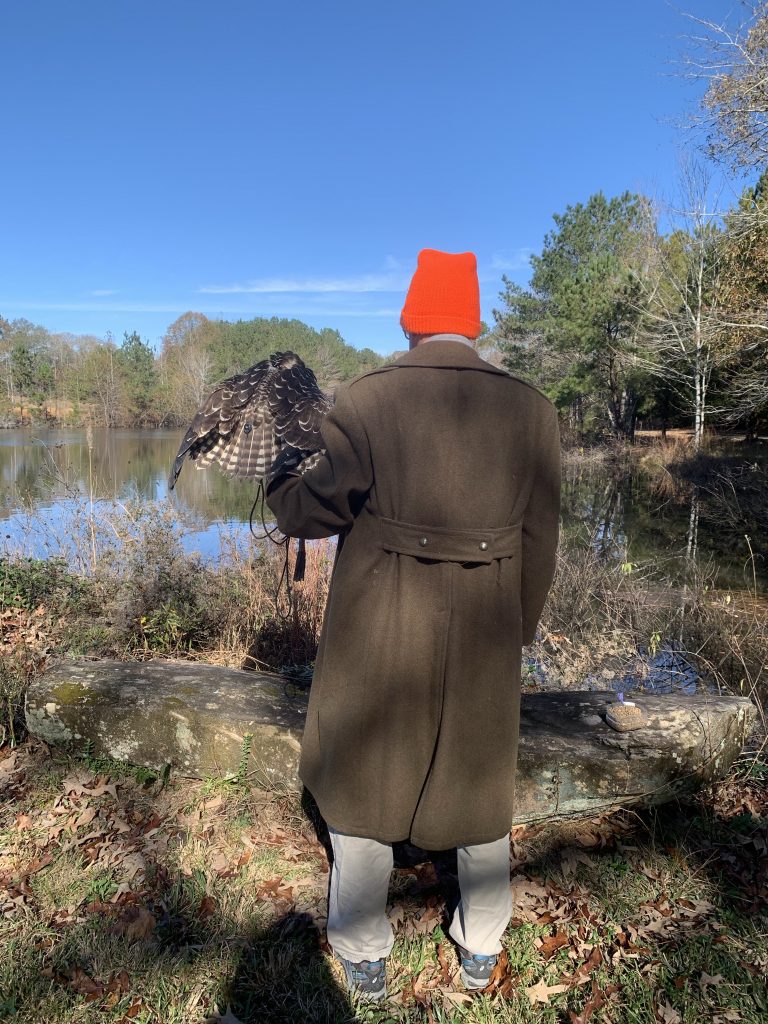
Orville has shown a couple of interesting behaviors. Upon approaching him with my long coat, he has responded defensively. The flapping coat may be simulating an attacking bird. When I approach him in the mews or on the ground, he will fly up, hover briefly and extend his open talons towards me, then land. He occasionally will touch my pants or shoes. No actual footing occurs; it seems like a bluff.
More interestingly, he flew up behind me and snatched off my hat without touching my scalp! It couldn’t possibly be a style issue (I am clearly up to date). This is the first time I have worn this hat. The color may have offended him; I can’t imagine the shape would. I normally wear a wide-brimmed camo hat.
Otherwise, he has been flying well, soaring, and returning for tidbits. He will return to whistle commands when I am out of sight.
Orville is flying a lot. He is slow to dive on fish partly because the fish have slowed so much that he has learned to just wait for me. I am still being cautious this time of the year, but so far he has returned without difficulties.
He will frequently dive in for a bath, lift off and fly around the lake in ground effect, then plop in again for another bath. He sometimes does this four or five times. His last takeoff is hard because he’s drenched.
He then flies a long time, with multiple shakes, to dry himself. I get a little nervous when he circles up a couple of hundred feet, and I’ll call him back to a fish when I get too worried.
One difference between ospreys and other common raptors is that they are exceedingly cautious about wind direction. If I call him from a perch, he will often take off in the opposite direction (if that’s the wind direction) and circle to approach me upwind.
He seems to fly more in high wind and tries more stunts–swoops and fast turns. In this brisk wind, he needs to worry about direction, but he considers the wind even when it is very light. He is cautious in winds a redtail would completely ignore. The clumsiness on landing, the long wings, the slowness to change directions seem to be the issue.
This bird is hooding, glove-riding, hawk-box-riding, and coming to tidbits very well. I think he will be a great falconry bird come spring when the fish get active. The tail-mount telemetry (sealed with silicone) and bare anklets are working fine. I may take him to some other ponds soon.
One trick I’ve learned when he loses attention with fishing and wants to beg from me is to throw a small tidbit in shallow water. He sometimes dives for it, but he always focuses his attention on the water and notices nearby fish.
I flew Orville on a couple of days. His weight is up about 20% above his hunting weight. I have been hooding and carrying him around for the past few weeks, and just had to see him flying again. His fist behavior and mews response has been so good, plus I have telemetry…
The first day he hunted lazily, but responded well. He took a very long bath, then swam back to the bank without even trying to fly off the water.
The second day (yesterday) he also hunted lazily, diving once after many minutes of head bobbing. He then took a long bath, lasting maybe five minutes. He flew off the water and headed out.
Silently, he began circling upwards, beating hard to gain some altitude, never glancing in my direction. He has never flown like this. My last bird exhibited this circling up behavior a year ago–right before he left.
Unlike last year, Orville finally returned to my offered fish but landed on his perch before flying one more leg over to me. All of this is odd. Something is going on in his brain regarding migration.
Weights have been of minor importance with my handling of ospreys since they would always come to a whole fish (not necessarily to a tidbit) if their crop was empty, regardless of weight.
You may have guessed that I will not fly him at high weights any more this fall. I may fly him back down below 1300g, but I probably shouldn’t do that until winter.
I wonder if the long baths are to hydrate before a long trip? I will do some Googling.
Individuals in Japan, the UK and the US have all gotten copies of the book. I look forward to any questions or discussion. IngramSpark is also publishing the book. It is possible than some non-USA readers can purchase it more easily through them. The clickable side link takes you to the Aerio store for IngramSpark.
Send a comment, if for some reason neither of these methods works. We should be able to arrange other options.
I’m going to stop free-flying Orville for a few weeks because now is the height of migration season. Even with this “vacation,” he will be kept in the mews less than most falconry birds. The fish have also slowed some. I will work with him on glove carrying, hawk boxing, and hooding.
I’ve been experimenting a lot. At weights around 1400-1440 grams, he is slow to return to small tidbits but immediately comes to large ones. He seems less eager in hunting. At 1300-1350 grams, he is reliable to the glove for about five small tidbits and also eager to hunt. He flies vigorously at all these weights.
He dives on every outing but has still only caught three fish at his home ponds. He has a much better success rate at another more heavily stocked pond.
I am very pleased with the ease of use and performance of the tail mount transmitter.